
Can I eat rice if I am trying to lose fat? Why we answer with “It Depends.”
Feb 03, 2026
Editor’s Note:
In 30 years of being a personal trainer, I have rarely given a one-size-fits all answer to a nutrition questions. The human body is a complex biochemical machine. What same exact thing that works for a 20-year-old athlete with high insulin sensitivity can destroy the progress of a 50-year-old with a history of metabolic damage.
Context matters.
The 30-Second Summary:
The Problem: People want a simple "Yes" or "No" on carbs.
The Reality: Your ability to handle rice depends on variables you probably aren't measuring: Glycogen storage capacity, muscle fiber usage, metabolic flexibility, fast twitch fiber usage, insulin sensitivity/resistance, etc.
Nuances: Example: Eating rice alone is biochemically different than eating rice soaked in vegetable oil. Some people think eating kapow moo sahp (stir fried pork with basil and rice) is simply “can I eat rice?”
The Solution: Trainer worth a darn…don’t guess. They certainly don’t make one assumption and assume that works for all clients. For example…”bananas are good for you.” Or “Bananas are bad for you.”
Professional trainers…don’t just look at the food. They understand they must assess the individual.
"Couch, can I eat rice?"
If you ask ten different trainers this question, you will get ten different answers based on their idealogy or feelings.
But nature…biochemistry…physiology…your endocrine system… doesn’t care.
When a client asks me or Ritah this at Flash Fitness, we can't answer them until I know the state of their current metabolic, hormonal and physiological state.
When we hand people paperwork when they first start at Flash, clients often are suprised. Just yesterday, a new client said I’ve never had a trainer ask this stuff before. 🤦♂️
“Rice" isn't just rice. Once consumed, it's a substrate that interacts with your specific physiology.
We need to figure out WHAT your body is likely to do with that rice.
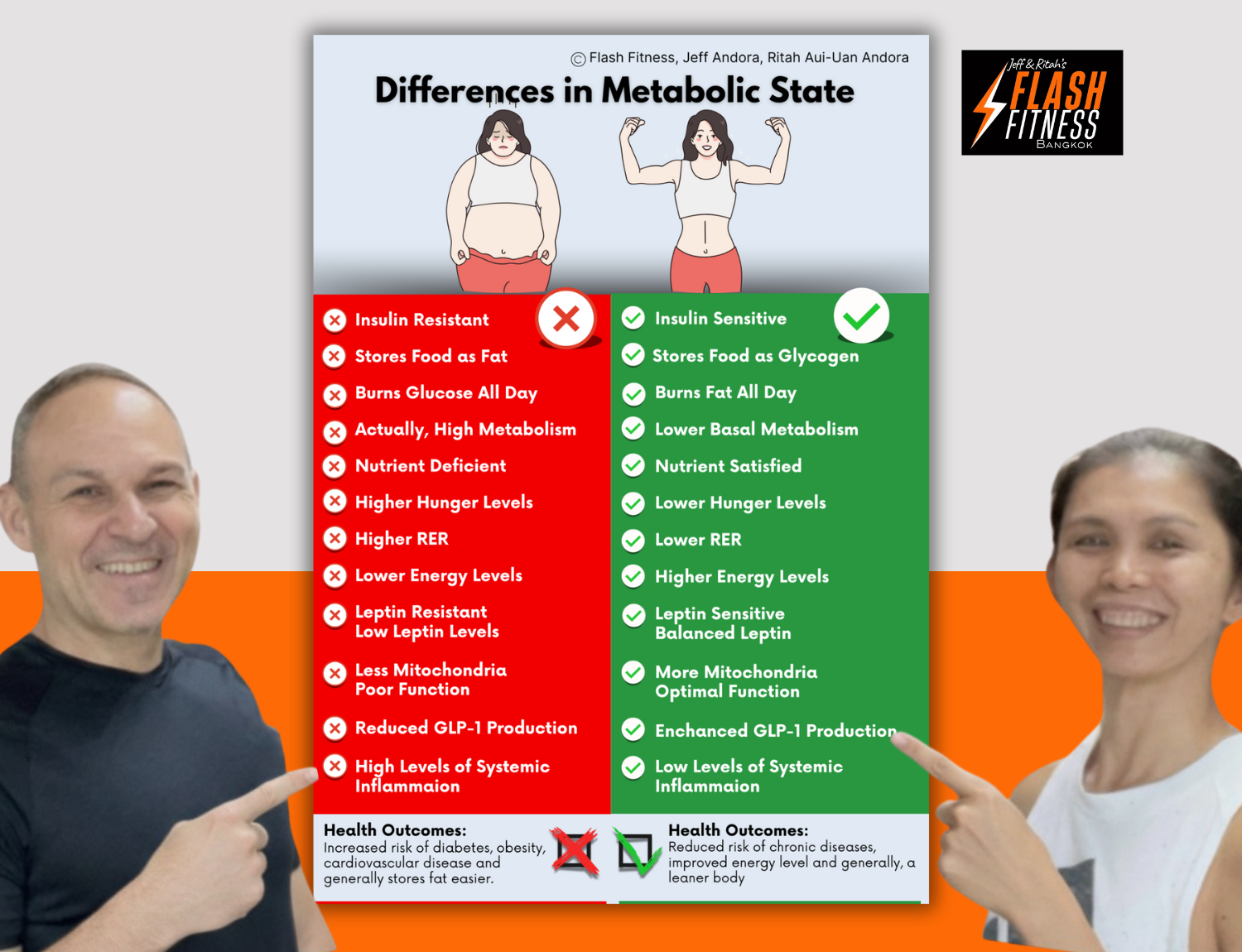
Some of the questions we have to answer before we decide if rice belongs on your plate.
How Much Glycogen Can YOU Store?
Muscles store carbohydrates as glycogen. But not everyone has the same size gas tank.
Two people can eat the same 300 calories of rice. One person stores it as muscle glycogen, the other person stores it as fat.
It wasn’t the “RICE” that was “good or “bad.”
A person with significant muscle mass has a much larger reservoir to store glucose than someone with low muscle mass.
Further, as person who is regularly depleting glycogen through proper exercise (not walking/yoga/pilates…these are NOT efficient glycogen burning activities) who is activating GLUT-4 pathways, can handle carbs better than someone who is not.
The Fast Twitch Factor: Are you training in a way that activates fast-twitch muscle fibers? These fibers that deplete glycogen rapidly. If you are only doing slow, low-intensity cardio, or stretching, or walking 10k steps a day…you aren't emptying the tank.
If glycogen tanks are full, that rice has nowhere to go but fat storage.
What Is Your Metabolic History?
This is an "invisible" variable almost no trainer gives thought to.
If you have been eating 3 high-carb, processed meals every day for 20-30 years years, your cells may very likely be resistant to insulin (Insulin Resistance).
The Resistant Client: Their cells reject the glucose, forcing the pancreas to pump out more insulin, decreasing fat usage and locking them in a fat-storage state.
The Sensitive Client: Their cells welcome the glucose and use it for glycogen storage, preparing it for the next PROPER workout.
Can you see how two people can eat the exact same bowl of rice. One gets leaner; the other gets fatter. The difference is HOW their body functions.
The "Fat" Context (The Fat + Carb problem)
Rarely do people eat dry white rice. In Bangkok especially, rice is often served fried in vegetable oils or paired with fatty meats.
From a metabolic standpoint, flooding the bloodstream with high glucose (rice) and high dietary fats (especially inflammatory seed oils) simultaneously creates an overload of energy. It messes with substrate oxidation…essentially insulin goes up…and the influx of easily used glucose means there is no need for all the fat at the moment. So, your body needs to put it somewhere…
Where do you think it goes?
A clean bowl of rice post-workout is a completely different biochemical event than oily fried rice at a dinner party when glycogen levels are full.
The Reality:
This is why Ritah and I don't write generic "meal plans."
We take each person as an individual.
* How carb tolerant are you? What kind of exercise are you doing?
* What is your visceral fat level? What does your bloodwork tell us?
* How was your sleep last night and overall stress levels (which affects glucose disposal)?
The Bottom Line:
Stop looking for "Good Foods" and "Bad Foods." Start looking at your body’s ability to process them.
If you don't know your own data, or if you don’t understand HOW the body works…admit that you are just guessing. And guessing is not a strategy.
Stop Guessing.
Do you know your glycogen capacity? Do you know your insulin sensitivity? If not, come see us. We build programs based on your body, not internet trends.
Does this better reflect the "Flash Fitness" standard? It leans into the complexity rather than ignoring it.
If you’d like to help getting on the right track, you can learn more about training with Ritah and myself here…www.flashfitnessresults.com.
Our gym is on Sathorn Road in Bangkok.
Take me to Flash Fitness